
Description
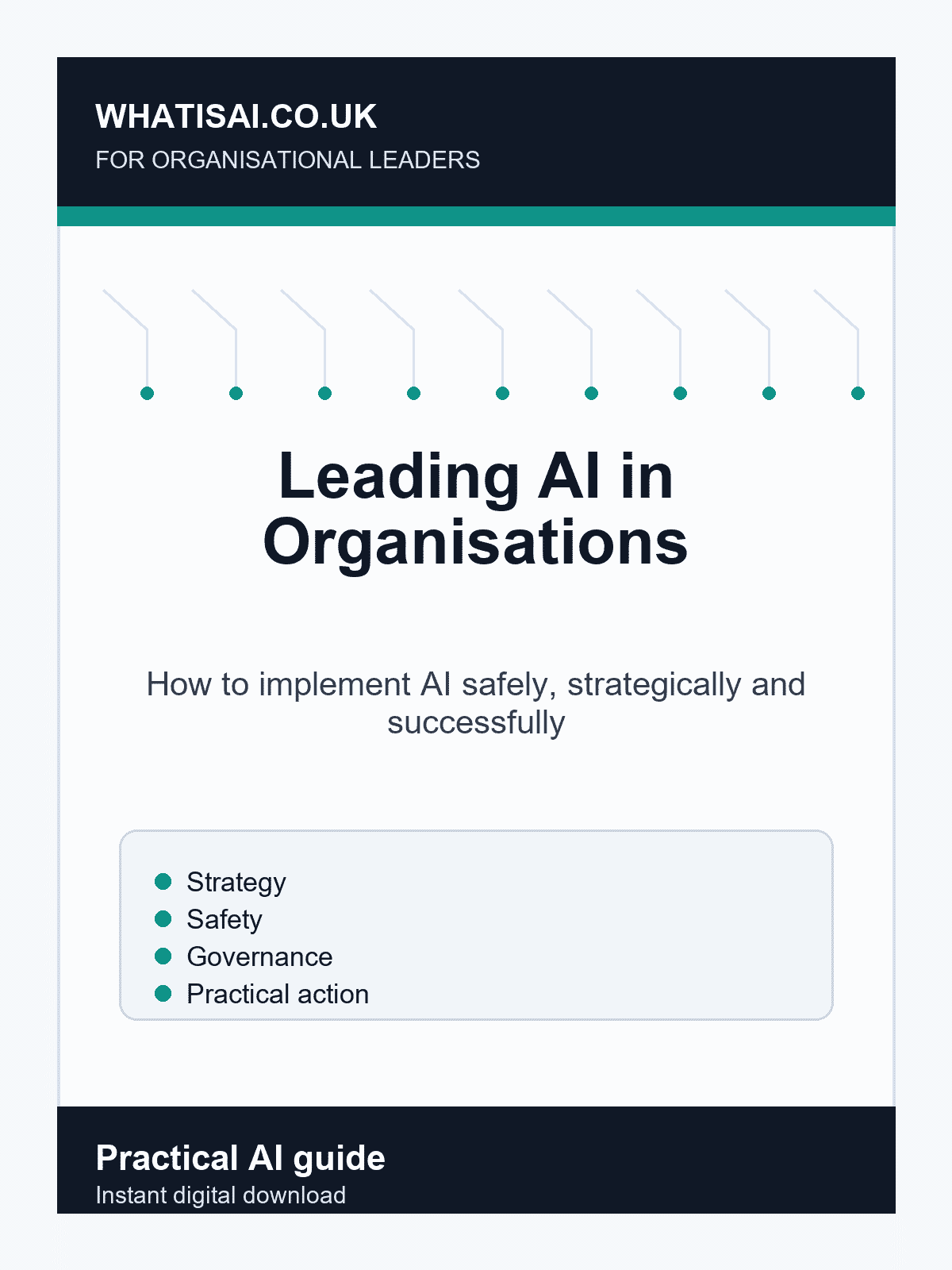
93-page digital leadership guide
Lead AI adoption with clarity, control and confidence
Leading AI in Organisations: How to Implement AI Safely, Strategically and Successfully is a plain-English guide by Adrian Precious MBA FCMI for executives, directors, boards, governance teams and senior decision-makers responsible for strategy, risk and operational performance.
It is designed to help organisations understand generative AI, identify where it can add value, manage risk, create policy and governance structures, train staff, communicate with stakeholders and put AI into practice through a clear 4-week action plan.
Who Leading AI in Organisations is for
| Best for | How it helps |
|---|---|
| Executives, directors and founders | Understand why AI belongs on the leadership agenda and how it links to strategy, performance and risk. |
| Boards and governance teams | Ask better questions about AI ownership, oversight, accountability, ethics and assurance. |
| Senior managers and operational leaders | Move from informal AI use to clearer policies, training, tool assessment and implementation routines. |
| Compliance, data and risk leads | Frame AI risks around GDPR, sensitive data, tool registers, traffic-light risk ratings and responsible use. |
What is included in the guide?
This is not a short checklist. It is a substantial leadership guide covering the full journey from understanding AI to implementing it responsibly across an organisation.
Practical appendices included
The guide also includes practical appendices that support implementation and internal discussion:
Appendix A: AI Governance Framework
A practical structure for AI tool usage areas, governance, review and oversight.
Appendix B: Organisational AI Governance Policy
A policy-style appendix covering acceptable use, prohibited use, tool approval, risk classification and responsibility.
Appendix C: AI Tool Assessment Checklist
A structured checklist for assessing tools, data use, risk, training, transparency and approval before adoption.
Appendix D: Traffic Light Risk Rating
A simple green, amber and red model for deciding which AI tools are low, medium or high risk.
Appendix E: AI Prompting Guide
Plain-English support for getting better outputs from AI while keeping human review and responsibility in place.
AI Glossary
A glossary of key AI terms to support non-technical leaders and governance discussions.
10 Leading AI in Organisations priorities covered
- Define how AI supports organisational goals.
- Assign accountability for AI governance and oversight.
- Develop an AI policy aligned with legal and ethical standards.
- Understand and manage data risks, including GDPR compliance.
- Create an AI registry of tools used across the organisation.
- Train staff in safe, effective and responsible AI use.
- Implement a structured risk assessment framework.
- Monitor usage, impact and unintended consequences.
- Communicate clearly with stakeholders.
- Review and adapt strategy as AI technology evolves.
Why buy Leading AI in Organisations?
Leading AI in Organisations is designed to save time and create structure. It gives leaders a practical way to discuss AI in plain English: what AI is, where it helps, where it creates risk, what needs governance, how staff should be trained and how implementation should begin.
Use it when you need to brief a leadership team, prepare for a board conversation, start an AI policy, create an AI registry, assess tools, improve staff confidence or move from scattered AI experiments into responsible implementation.
How Leading AI in Organisations fits with the AI Governance UK article
The AI Governance UK keystone article explains the wider governance framework. This paid guide goes deeper into organisational leadership, adoption, culture, data protection, communication and practical implementation.
If the article explains why governance matters, this guide helps you start the internal leadership conversation and implementation work.
External context for responsible AI adoption
The guide is written as practical leadership support. For external reference, organisations may also want to compare their approach with the UK Government AI Playbook and the ICO guidance on AI and data protection.
FAQ
Is this a digital download?
Yes. It is a downloadable 93-page PDF guide for practical leadership and governance use after purchase.
Is it suitable for non-technical leaders?
Yes. It is written in plain English for decision-makers, not developers or technical AI specialists.
Does it include policy and checklist material?
Yes. The appendices include an AI governance framework, organisational AI governance policy, tool assessment checklist, traffic-light risk model and prompting guide.
Does it replace legal advice?
No. It is a practical leadership and governance guide, not legal, safeguarding or data protection advice.